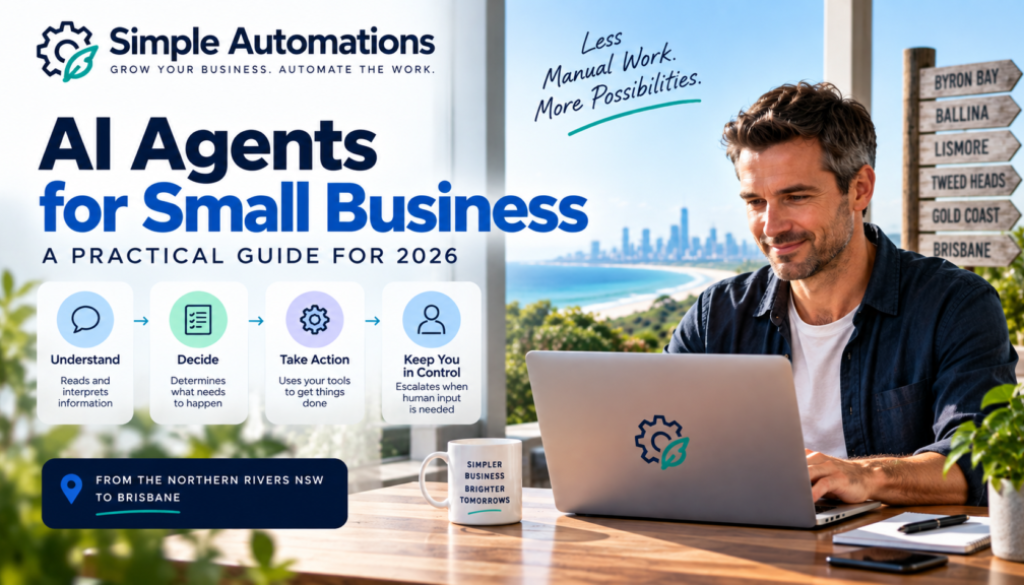
AI Agents for Small Business: A Practical Guide for 2026
AI is becoming increasingly useful for small businesses, but there is an important difference between using AI to answer a question and having AI actually help carry out a business process.
That’s where AI agents for small business come in.
An AI agent can be designed to understand information, work through a task, make decisions within defined boundaries and take actions using the tools available to it.
That could mean reading a customer enquiry, deciding what type of enquiry it is, checking information, updating a system and escalating the conversation to a person when human involvement is required.
It sounds complicated, but the underlying idea is quite simple.
Give technology a job to do, define the boundaries, and let it handle the repetitive work while people remain in control.
This guide explains what AI agents are, how they differ from traditional automation, what small businesses can use them for and how to decide whether an AI agent is appropriate for your business.
What Is an AI Agent?
An AI agent is a software system that uses artificial intelligence to understand information, determine what needs to happen and carry out actions to achieve a defined objective.
That makes an AI agent different from a simple chatbot or an AI tool that only generates text.
A basic AI tool might answer:
“What should I say in an email to this customer?”
An AI agent could potentially be given a broader task:
“Review new customer enquiries, determine what each customer needs, record the information, provide an approved response where appropriate and alert me when I need to get involved.”
The agent is therefore working as part of a process rather than simply producing an answer.
The exact capabilities of an AI agent depend on how it is designed, what information it can access and what actions it has been authorised to take.
How Are AI Agents Different From Automation?
This is one of the most common questions businesses have when they first encounter AI agents.
Traditional automation generally follows predefined instructions.
For example:
If a customer completes this form, add their details to the spreadsheet and send an email.
An AI agent can introduce another level of interpretation.
For example:
Read the customer’s enquiry, determine what they need, decide which approved process applies and take the appropriate action.
The difference becomes easier to see in a simple comparison.
| Traditional Automation | AI Agent |
|---|---|
| Follows predefined rules | Can interpret information |
| Works best with predictable inputs | Can handle more varied information |
| Performs defined actions | Can determine which action is appropriate |
| Usually follows a fixed workflow | Can work through a task using defined goals and boundaries |
| Highly predictable | Requires appropriate controls and oversight |
However, it is important not to think of AI agents and automation as competing technologies.
In many cases, they work best together.
AI agent: Understands the information and determines what should happen.
Automation: Carries out predictable actions between business systems.
Human: Handles decisions that require experience, judgement or personal interaction.
If you want to understand the broader role of automation in a small business, see our small business automation solutions.
How Do AI Agents Work?
You don’t need to understand the technical details to understand the basic process.
Think of an AI agent as having a job, access to relevant information and a set of rules about what it is allowed to do.
A typical process might look like this:
1. Something happens
A customer sends an email, a form is submitted or a new document arrives.
2. The AI agent receives the information
The agent analyses the information and works out what it means.
3. The agent determines what needs to happen
It uses its instructions, available information and defined rules to determine the next step.
4. The agent takes an approved action
This could involve creating a record, preparing a response, updating a system or starting another workflow.
5. The process continues
Other automation can perform predictable steps.
6. A person gets involved when required
If the situation falls outside the agent’s instructions or requires human judgement, the process can be passed to a person.
This combination of AI and automation can make complicated business processes much easier to manage.
What Can AI Agents Do for a Small Business?
There are many potential applications for AI agents for small business, but the best opportunities are usually tasks where someone currently has to read, interpret, decide and then perform several repetitive actions.
Customer Enquiries
Imagine a business receives enquiries through email throughout the day.
Some customers want pricing information. Others want to know about availability. Some may be asking for support, while others may be potential new customers.
Manual process:
Someone reads every enquiry and works out what needs to happen.
AI agent solution:
The agent reads the enquiry, identifies the customer’s intent and follows the appropriate approved process.
Result:
Routine enquiries can be handled more efficiently while more important enquiries are brought to the attention of the business owner.
Lead Follow-Up
Following up leads is important, but it is easy for a busy business owner to forget.
An AI agent could potentially review incoming enquiries, determine whether someone appears to be a genuine sales lead, record the information and initiate an approved follow-up process.
The agent doesn’t need to make the final sales decision.
It can simply make sure the administrative work surrounding the lead happens consistently.
Email Management
Email inboxes can contain dozens of different types of messages.
An AI agent can potentially identify what an incoming message is about and determine which workflow should apply.
For example:
- Sales enquiry → send to sales workflow.
- Customer support → create support task.
- Invoice → send to finance workflow.
- Document → save and notify the appropriate person.
- Routine question → provide approved information.
This can turn an inbox from a manual sorting exercise into a more organised business process.
Document Processing
AI agents can also be useful where information arrives in different formats.
For example, a business might receive a PDF containing customer information, an invoice or an application.
The agent can potentially identify the important information and then pass it to an automation that updates the appropriate business system.
Where the information is sensitive or the consequences of an error are significant, human review can remain part of the workflow.
Customer Support
An AI agent can potentially help with customer support by identifying common questions and providing responses based on approved information.
More complicated issues can be escalated to a person.
This can be particularly useful for businesses that receive many similar questions but don’t want customers to feel that every interaction is being handled by an automated system.
Reporting
AI agents can also help gather and interpret information.
For example, an agent could collect information from different systems, identify important changes and prepare a summary for the business owner.
The result could be a regular report that requires much less manual preparation.
AI Agents Don’t Have to Work Alone
One of the biggest misunderstandings about AI agents is that they have to do everything themselves.
They don’t.
In fact, an AI agent can be just one part of a larger automated workflow.
For example:
Customer enquiry arrives
↓
AI agent reads the enquiry
↓
AI agent identifies the enquiry type
↓
Automation records the customer
↓
Automation sends approved information
↓
Follow-up task is created
↓
Human handles anything requiring personal attention
This is often a much more practical approach than asking an AI agent to control an entire business process by itself.
AI Agent vs Chatbot
AI agents and chatbots are often confused because both can communicate using natural language.
A chatbot is primarily designed to have a conversation with a user.
An AI agent can potentially go further by carrying out actions as part of a task.
For example, a chatbot might answer:
“Our business hours are 9am to 5pm Monday to Friday.”
An AI agent could potentially receive a customer’s request, determine that they want to book an appointment and then interact with the appropriate booking system, subject to the permissions and workflow it has been given.
That doesn’t mean every business needs an AI agent.
A simple chatbot may be the better solution if the business only needs to provide information.
The technology should match the problem.
AI Agent vs AI Assistant
An AI assistant is generally designed to help a person with tasks such as writing, research, summarising information or answering questions.
An AI agent is more focused on carrying out a defined objective and taking actions within the permissions it has been given.
The distinction isn’t always absolute because modern AI systems can combine both capabilities.
For a small business, the more useful question is:
“What do I actually need the system to do?”
If you need help creating content or summarising information, an AI assistant may be sufficient.
If you need a system to monitor incoming enquiries, determine what they mean and initiate the appropriate business process, an AI agent may be more appropriate.
What Should an AI Agent Be Allowed to Do?
This is an important question.
Just because an AI agent can perform an action doesn’t mean it should automatically be given permission to do so.
A well-designed AI agent should have clearly defined boundaries.
For example, an agent might be allowed to:
- Read incoming enquiries.
- Categorise messages.
- Create customer records.
- Prepare responses.
- Send approved routine information.
- Create tasks.
- Update specific fields.
- Escalate unusual situations.
But a business might decide that the agent should not be allowed to:
- Approve large payments.
- Make significant financial decisions.
- Delete important records.
- Commit the business to a contract.
- Provide advice outside its approved information.
- Make sensitive decisions without human review.
The more significant the consequence of an action, the more important appropriate controls become.
Human Oversight Still Matters
AI agents are powerful, but they aren’t infallible.
An AI system can misunderstand information, make an incorrect classification or produce an inappropriate response.
That’s why good AI agent automation includes appropriate human oversight.
A useful approach is to divide actions into three categories.
Low-Risk Actions
These are tasks where an incorrect result has limited consequences.
Examples might include organising information or creating an internal task.
Medium-Risk Actions
These may be automated but could benefit from review depending on the circumstances.
Examples might include preparing customer responses or categorising leads.
High-Risk Actions
These should generally have strong human involvement.
Examples include significant financial decisions, contractual commitments or decisions involving sensitive personal information.
The objective isn’t to eliminate humans from the process.
It’s to make sure humans spend their time where their judgement matters most.
What Software Can AI Agents Work With?
AI agents can potentially be connected to many of the systems a small business already uses.
Depending on the workflow, this could include:
- CRM systems
- Spreadsheets
- Accounting software
- Online forms
- Customer databases
- Project management systems
- Ecommerce platforms
- Calendar and booking systems
- Document storage
Automation platforms such as Make and Zapier can be used to connect applications and automate workflows.
AI services such as OpenAI and Claude can provide AI capabilities for workflows that need to understand, generate or summarise information.
The exact combination depends on what the business is trying to achieve.
Again, the starting point should be the business problem rather than the technology.
How Do You Know If Your Business Needs an AI Agent?
Not every automation needs AI.
If a process follows exactly the same steps every time, traditional automation may be the simpler and more reliable option.
An AI agent becomes more interesting when the process involves information that varies from one situation to another.
Ask yourself:
- Does someone have to read information before deciding what happens next?
- Does the information arrive in different formats?
- Do customers describe the same problem in different ways?
- Does someone have to categorise or interpret information?
- Could the process benefit from a system deciding which predefined workflow applies?
If the answer is yes, an AI agent may be worth investigating.
When Traditional Automation Is Better
There are many situations where you don’t need an AI agent.
For example, imagine you want to:
- Copy a form submission into a spreadsheet.
- Send an automatic confirmation email.
- Create a calendar event.
- Move a file into a folder.
- Send a reminder after a fixed period.
These tasks have clear rules.
Adding AI could make the system more complicated without providing any meaningful benefit.
This is why good automation design starts with the process rather than the latest technology.
AI Agents for Australian Small Businesses
For small businesses in Australia, AI agents can provide an opportunity to automate processes that previously required someone to constantly monitor information and decide what should happen next.
This can be particularly useful for businesses where the owner is also responsible for administration, sales and customer service.
Businesses across the Northern Rivers, Northern NSW, Gold Coast and Brisbane may have very different industries and customers, but many face similar administrative challenges.
Whether you’re running a trade business in Tweed Heads, a professional service in Brisbane, an ecommerce business on the Gold Coast or a consultancy in the Northern Rivers, the same principle applies:
Find the repetitive work. Understand the process. Decide where human judgement is needed. Then automate the appropriate parts.
How to Start With AI Agents
If you’re considering AI agents for small business, don’t start by trying to build the most advanced system possible.
Start with one real business problem.
Step 1: Identify the Problem
Find something that consumes time regularly.
Step 2: Map the Current Process
Write down every step from beginning to end.
Step 3: Identify Where Decisions Occur
Look for points where someone has to read information and determine what happens next.
Step 4: Identify the Repetitive Actions
Look for emails, data entry, record creation, notifications and other predictable actions.
Step 5: Decide What the AI Agent Should Handle
Give the agent a clearly defined role rather than unrestricted control.
Step 6: Define the Boundaries
Decide what the agent can do, what requires approval and what should always be handled by a person.
Step 7: Test Before Relying on It
Run the process with real-world examples and check the results carefully.
Step 8: Improve Over Time
Once the workflow is working reliably, look for ways to improve it rather than immediately adding more complexity.
Start With One Useful Job
The biggest mistake businesses can make with AI agents is starting with the technology rather than the problem.
You don’t need an AI agent simply because AI agents are becoming popular.
You need one when there is a business process that could genuinely benefit from having technology interpret information and take appropriate actions within defined boundaries.
That might be customer enquiries.
It might be lead follow-up.
It might be email management.
It might be document processing.
It might be reporting.
Or it might be a process unique to your business.
The best automation is usually the one that quietly removes work you don’t need to be doing.
AI Agents and the Future of Small Business Automation
AI agents are likely to become an increasingly useful part of business automation as the technology becomes easier to integrate with the software businesses already use.
But the underlying principles will remain the same.
Businesses need reliable processes.
People need appropriate control.
Technology needs clear boundaries.
And automation needs to solve a real problem.
The future isn’t necessarily about having an AI agent running every part of your business.
It is about using AI where it adds genuine value and combining it with traditional automation and human expertise where each is most appropriate.
Ready to Explore AI Agents for Your Business?
You don’t need to understand how AI agents are built to start exploring what they could do for your business.
Start by looking at the repetitive tasks that currently require someone to read information, make a simple decision and then carry out a series of predictable actions.
That could be the opportunity.
Simple Automations helps small businesses identify practical opportunities for AI and automation, then design solutions around the way the business already works.
From the Northern Rivers and Northern NSW through the Gold Coast to Brisbane, our focus is on making automation practical, understandable and useful for small businesses.
Whether you want to explore automation yourself or would prefer someone to design and build it for you, the objective remains the same:
Grow Your Business. Automate the Work.
Explore Simple Automations Solutions →
For more practical information about AI, automation and business workflows, visit the Simple Automations Business Hub.